


Hungarian goulash - straight from the Puszta
October 14th, 2018 | Landgänge
From Budapest we made our way to the Hungarian Puszta. If there is a “real” Hungarian goulash somewhere, then in Hortobágyi, a small town in the middle of the Puszta. On the bridge market (Hídivásár), which is celebrated annually on the national holiday in Hortobágyi, we found it. Here it boiled and bubbled in large cauldrons. And we brought the recipe…
In search of the Hungarian goulash
A good two and a half hours we drove by car with our dear friend, the ship’s doctor, until we saw the landmark of Hortobágyi: the “Nine Arch Bridge”. Never before had I seen so many storks and sunflowers anywhere as on the way there. Just overwhelming. And I have not experienced such a heat. Although we really had a hot summer in 2018 even in northern Germany and the temperatures in the Puszta “allegedly” about the same, it felt really different. Pungent. Hot. Barely unsustainable.
The Puszta of Hortobágyi is the largest and most famous Central European steppe area, it was declared a World Heritage Site in 1999. Here in the center of this national park, right next to the Nine Arch Bridge, you will find the bridge market, a shepherd’s museum, a bird clinic and a very good restaurant. But one after another:
Hortobagyi breathes history
A visit to the small shepherd’s museum is highly recommended. In the old building from 1785 you can get an overview of the living conditions of earlier times in the Puszta. How did shepherds live, work, dress and… how did they cook their goulash…
The restaurant Czárdas is also worth a visit. In the newly renovated buildings next to the former Salt Road, right by the Nine-Arch Bridge, travellers have been spoiled with good Hungarian food for more than 300 years. The hearty pancakes stuffed with meat from the Hungarian grey cattle are even known throughout the country as “Hortobágyi-style pancakes”. And of course, how could it be otherwise, there is also an excellent goulash here…


In the search for the ultimate goulash, we should not miss out on the Madárpark Birding and Repatriation Station: For nearly 20 years, wounded animals, especially birds (and, as it seems, mostly storks), have been treated, cared for, and end up in several stages re-released. A really impressive facility!


Goulash kettle on the bridge market
The large, annual bridge market also takes place directly at the Nine Arch Bridge: it’s something between a folk festival and a craft market and you can buy all Hungarica for which Hungary is famous: basketwork, crockery, goulash pots from very small to huge, glasses, knives, peppers, salami, skins and leather, antiques, wine and – of course – goulash from large kettles for little money. Here we are right!

Gulyas, Pörkölt, Paprika - same, same, but different
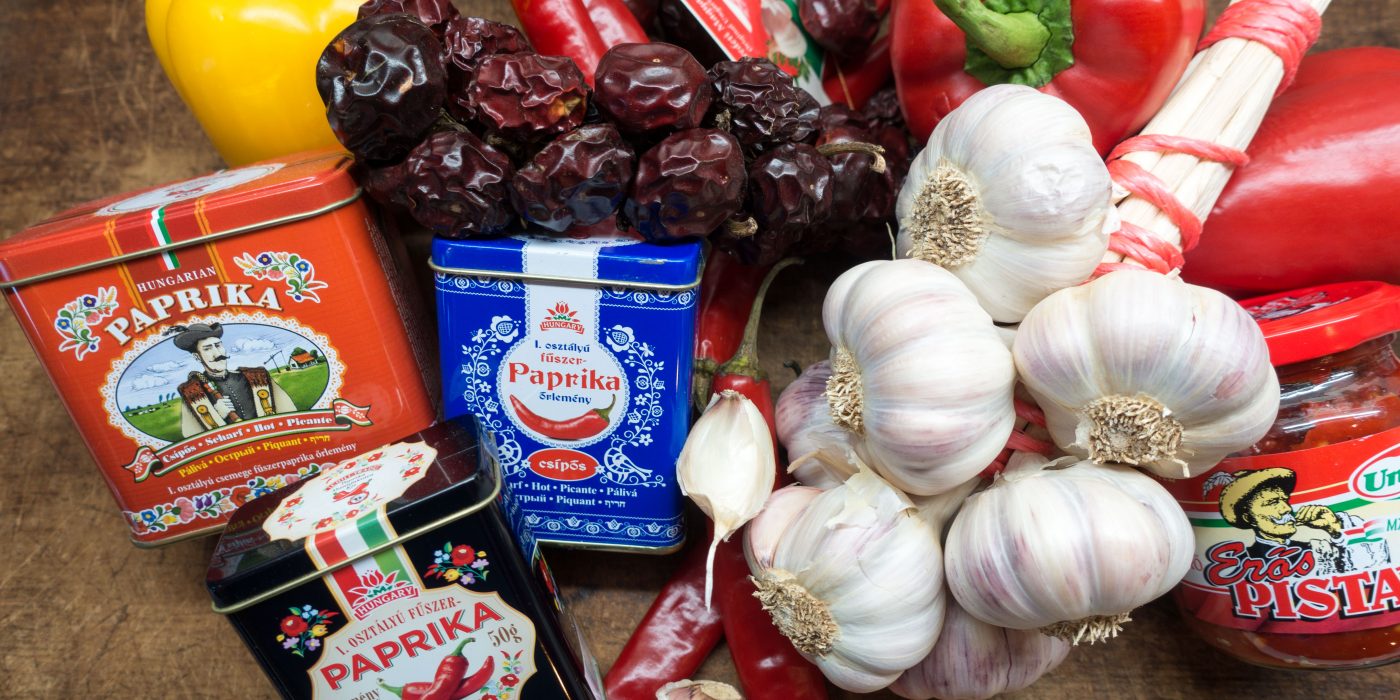
Goulash is omnipresent in Hungary. There is hardly a restaurant without it on the menu. Served on rustic enamel plates or in small stainless steel kettles, there seems to be an infinite number of types of preparation. Goulash in Hungary is always a soup with peppers, onions and potatoes. Gulyás means nothing else than “made by a shepherd”.
Pörkölt is more like our German goulash, also with peppers, many onions and a thickened sauce. Paprikás, on the other hand, is made with white meat (eg veal), it usually contains less paprika and onions, but it is refined with sour cream.
The spiciness for all three dishes is basically brought in later at the table. Hot, fresh peppers or chillies or hot to hellish-hot chili paste are served at the table, so any one can dose at will or fortune. Incidentally, my dearest captain is a phenomenon here, even for Hungary. He can eat unbelievably (!) hot.
Here is the Puszta recipe for a fine Hungarian Goulash, even if it is perhaps more a Pörkölt – or at least a Paprikás?
Hungarian goulash

(serves 4 – 6)
If you want to enjoy your goulash with spaetzle, you’ll find the recipe here.


 Tags:
Tags: Leave me a message

Use of leftovers: Fish cakes made from cooked fish
Cooking with leftovers is not only sustainable, but also a creative way to conjure up delicious dishes. This easy recipe turns cooked fish into deliciously juicy fish cakes while creating a whole new dish from leftovers.
read more
Really wild wild herbs salad
What they sell on the domestic German markets as “wild asparagus” botanically is no asparagus. Of course wild asparagus exists, and I know it from my time in northern Spain, where we collected the wild asparagus in nature. Here in Germany, however, the flower sprouts of the Pyrenean Star of Bethlehem are offered under this term, mostly grown in France. And it is really delicious. Raw or steamed, it tastes very intense. For a wild herb salad a “snappy” enrichment.
read more
Red wine and vegetable goulash on mashed potatoes with turmeric
Soul food at its finest: tasty vegetables in a velvety red wine sauce, served with golden mashed potatoes with turmeric. An irresistible vegetarian winter dish!
read more